BELIEFS AND CUSTOMS

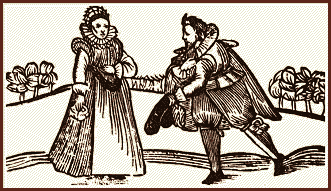 Marriage customs
of the Elizabethan Era are not much different from the traditional marriages of
today. Like some religions, after the formal betrothal the banns were published
(the announcement of the couple's intent to marry.) The minister publicly announced
in church asking the gatherers if they might have any objection, and if so, to
state so before the formal ceremony. If the couple wanted to hurry up the process,
a special license from the bishop would be required.
Marriage customs
of the Elizabethan Era are not much different from the traditional marriages of
today. Like some religions, after the formal betrothal the banns were published
(the announcement of the couple's intent to marry.) The minister publicly announced
in church asking the gatherers if they might have any objection, and if so, to
state so before the formal ceremony. If the couple wanted to hurry up the process,
a special license from the bishop would be required.Early on the morning of the wedding, bridesmaids, the groom with his attendants, musicians and friends would gather at the bride's home. The entire party would then set off for the church. After the ceremony there was much dancing, drinking, feasting and game-playing. Guests would continue to celebrate even after the bride and groom had departed.
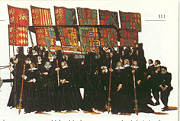 Funerals were
very elaborate if one was a member of nobility. The covered coffin was carried
to the grave by black clad pallbears. The long procession of mourners followed
wearing hooded cloaks. The coat of arms was painted on flags, arranged by one
of the family heralds. The body was buried inside the church. After the funeral,
mourners feasted, and money was collected and given to the poor.
Funerals were
very elaborate if one was a member of nobility. The covered coffin was carried
to the grave by black clad pallbears. The long procession of mourners followed
wearing hooded cloaks. The coat of arms was painted on flags, arranged by one
of the family heralds. The body was buried inside the church. After the funeral,
mourners feasted, and money was collected and given to the poor.
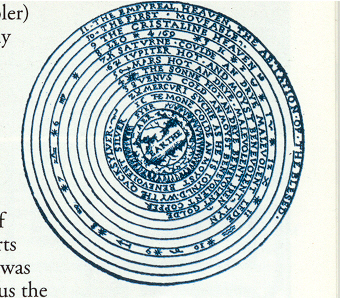 Elizabethans
believed that there were seven planets--the moon, Mercury, Venus, Sol(the sun),
Mars, Jupiter, and Saturn--and that they rotated around the earth in concentric
circles. They believed that the earth was the center of the universe, fixed firmly
in place. The "planets" affected the affairs of the earth, and astrologers felt
that they could predict future events by knowing the conjunction of the stars.
The movements of the stars and the appearance of comets and eclipses were believed
to be the origin of disaster. At left is a 16th century engraving showing Ptolemy's(2nd
century AD) system of the universe with its concentric spheres.
Elizabethans
believed that there were seven planets--the moon, Mercury, Venus, Sol(the sun),
Mars, Jupiter, and Saturn--and that they rotated around the earth in concentric
circles. They believed that the earth was the center of the universe, fixed firmly
in place. The "planets" affected the affairs of the earth, and astrologers felt
that they could predict future events by knowing the conjunction of the stars.
The movements of the stars and the appearance of comets and eclipses were believed
to be the origin of disaster. At left is a 16th century engraving showing Ptolemy's(2nd
century AD) system of the universe with its concentric spheres.  Bells were a major
source of communication for Elizabethans. The church bells called the faithful
to services on Sundays and Holy Days, announced good news, gave an alarm for fire
or war and celebrated various occasions, including weddings and funerals. The
bells rang continuously during fearful times - such as an epidemic or the plague.
When someone died, only an ominous single bell sounded.
Bells were a major
source of communication for Elizabethans. The church bells called the faithful
to services on Sundays and Holy Days, announced good news, gave an alarm for fire
or war and celebrated various occasions, including weddings and funerals. The
bells rang continuously during fearful times - such as an epidemic or the plague.
When someone died, only an ominous single bell sounded.
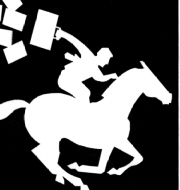 Although there
was no postal service for the general public, there was a regular system of
messengers on horseback used for official business. If an emergency existed,
a postmaster at any of the stations along the route could conscript(take at
will) a horse belonging to anyone in order to get the message through.
Although there
was no postal service for the general public, there was a regular system of
messengers on horseback used for official business. If an emergency existed,
a postmaster at any of the stations along the route could conscript(take at
will) a horse belonging to anyone in order to get the message through.
World Events |
Fashions |
Everyday Living |
The Plague |
Recreation & Sports |
Crime and Punishment |
Education |
Customs & Beliefs |